My name is Jelena Komazec, I am 24 years old and I come from Belgrade, Serbia. For the past few years, however, Slovenia has become a very important part of my life. I completed my Bachelor’s degree in Environmental Sciences at the University of Nova Gorica, and I am currently finishing my Master’s degree in Nature Conservation at the University of Primorska. This year, I also became an IVY volunteer at the University of Primorska as part of the project GOmini – Hidden Natural Heritage of the Cross-Border Area for Young Generations.
For me, joining IVY was not only an opportunity to gain new experience. Slovenia is a place that has given me many opportunities to study, learn, meet people and grow, both professionally and personally. Becoming an IVY volunteer felt like a meaningful way to give something back to an area that has become very important to me. I was also excited about the possibility of combining several things that I care about – nature conservation, environmental education and working with people. These were already some of the main reasons why I applied for IVY in the first place.
Discovering the nature we often overlook
The main idea behind GOmini is actually quite simple: to help people discover the nature that is all around us, but that we often do not notice. GOmini is financed by the European Union through the Small Project Fund GO! 2025 of the Interreg VI-A Italy–Slovenia 2021–2027 Programme, managed by EGTC GO.
The project focuses on small and sometimes overlooked green and aquatic habitats in the cross-border area between Slovenia and Italy. These can be places very close to us, such as cities, gardens and agricultural landscapes, but also ponds, forests, rivers, wetlands and other habitats. Although some of them may not seem particularly special at first sight, they can support a surprising amount of biodiversity.
Through eight bilingual nature workshops, children, families and other participants have a chance to explore these environments more closely. One of the most interesting parts of the workshops is the use of digital microscopes, which allow us to discover details and organisms that would otherwise be almost invisible to us. Participants are also encouraged to record short videos of the “mini” nature they discover. Some of these recordings will later contribute to a documentary about the hidden natural heritage of the cross-border area.
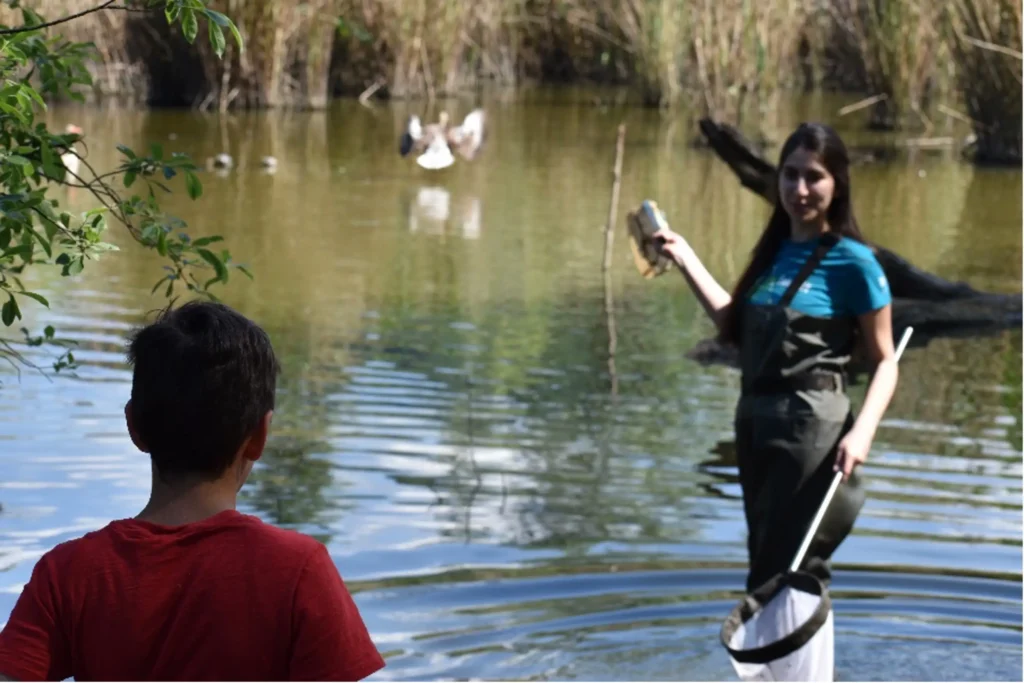
A large part of my own work as an IVY volunteer revolves around these workshops. I help prepare educational booklets for children, develop activities, communicate with participants, present the project to different groups and, most importantly, take part in the workshops themselves. I have also been presenting our action for collecting nature videos to children in different settings, including summer programmes and a youth film camp. These activities are closely connected to my role as an IVY Project Partner, which is to support the concrete activities of an Interreg project and help make its work and results more visible.
A drop of water can be enough
One of the moments that stayed with me happened during our very first workshop, Pond, in Borov gozdiček in Nova Gorica.
We collected several small water samples and observed them using a digital microscope connected to a screen. The children were immediately fascinated by what appeared on the screen. Something that had looked like just a little bit of pond water suddenly became full of structures, colours and life. They were especially interested in the algae, and what started as simple observation quickly turned into questions and a chance to learn more about what they were seeing. Moments like this are probably my favourite part of the project.
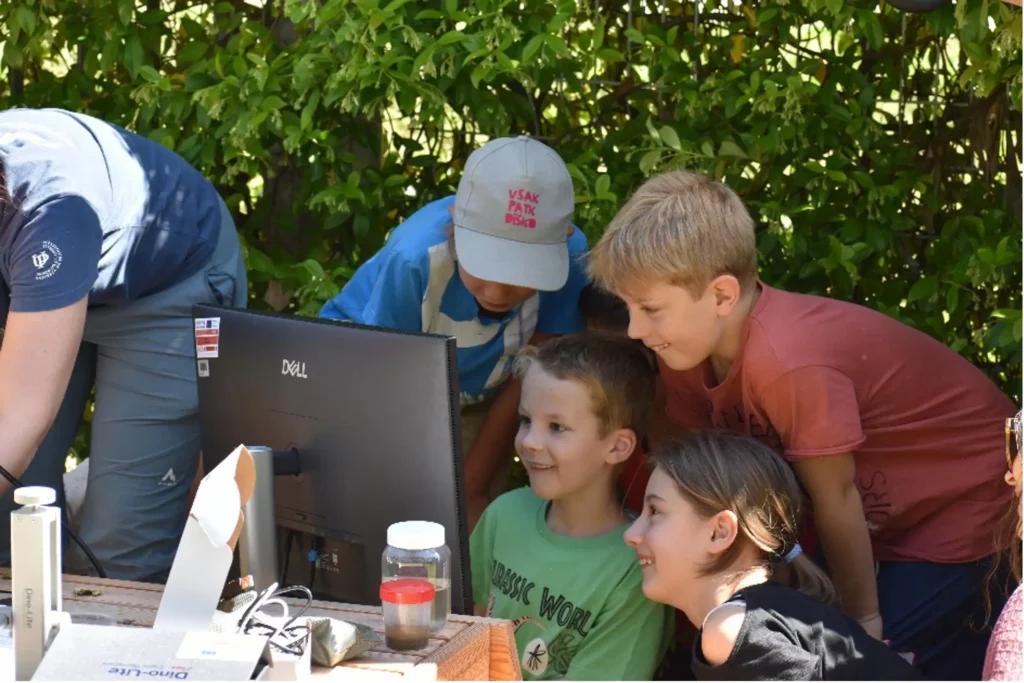
What has surprised me is how little it sometimes takes to spark genuine curiosity. If children are given the opportunity to explore something themselves, rather than only being told about it, even a very small organism can suddenly become incredibly interesting.
And the best sign that the workshops stay with the children is what happens afterwards. Children and parents often ask us when the next workshop will be and whether they can join again. Several children have already taken part in more than one of our workshops. Seeing them return, still excited to explore something new, has been one of the most rewarding parts of the experience for me.
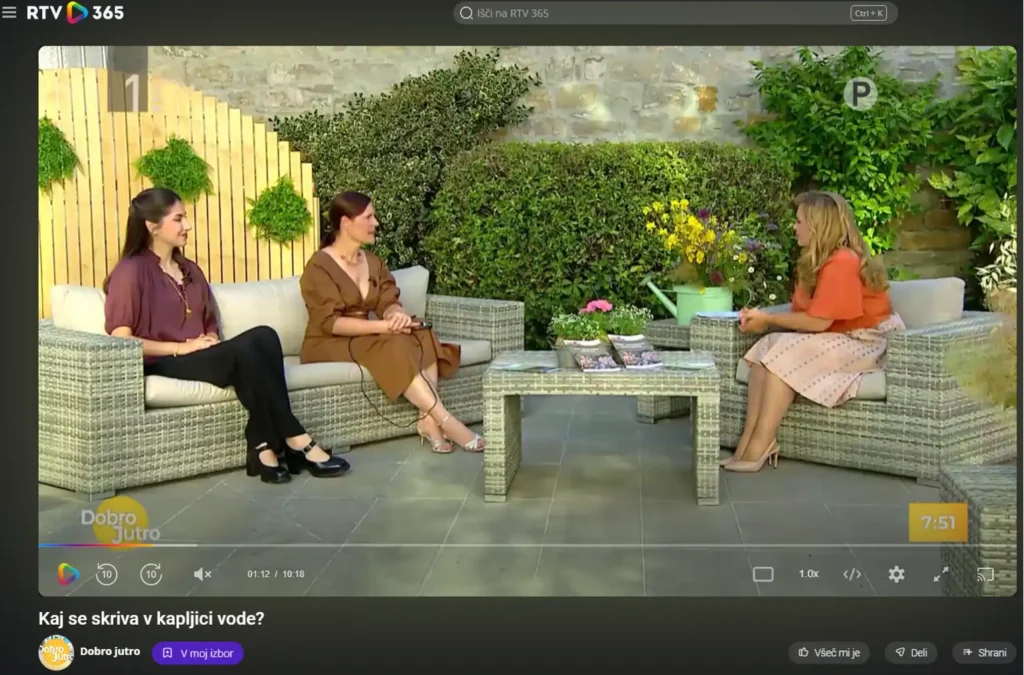
Another very memorable moment was presenting GOmini together with our project leader and my mentor, Associate Professor Živa Fišer, on the Slovenian television programme Dobro jutro. It was my first experience appearing on television, so it was definitely outside my usual comfort zone, but also something I was very happy to be part of. It gave us an opportunity to present the project and our workshops to a much wider audience.
What happens behind one workshop
Through GOmini, I have also learned how much work happens behind something that may look quite simple from the outside.
A workshop may last only an hour or two, but before it happens, there is research, preparation of educational materials, communication with participants, promotion, organisation of equipment, planning activities, finding suitable locations and many other activities.
Before IVY, I had mostly experienced nature conservation from the academic and scientific side. Through this project, I am discovering how much I enjoy another side of it as well – preparing activities, organising, presenting scientific topics in a simpler way and communicating them to different audiences. The experience has helped me realise that I would like to continue doing something similar in the future. I enjoy studying nature, but I also really enjoy finding ways to share that knowledge with others.
Nature does not recognise borders
Before becoming an IVY volunteer, I knew very little about Interreg. Today, I understand it much more through practice than through definitions.
GOmini is a good example of why cross-border cooperation matters. Nature does not recognise the borders that we draw on maps. Species, rivers, forests and ecosystems continue from one country into another, and many environmental challenges are shared as well. The cross-border area between Slovenia and Italy is especially interesting in this respect, because many habitats and landscapes form one connected natural space even though they are divided administratively. The project itself is based on this idea and aims to strengthen cooperation and understanding across the border through joint activities and bilingual materials.
Through IVY, Interreg has therefore become much less abstract to me. I now see it in children looking through a microscope, families coming back to another workshop, people working together across languages, and a shared interest in protecting the nature around us.
IVY was created exactly to make this kind of cooperation more visible and to show the human side of European Territorial Cooperation. I think GOmini does that in a very natural way: by starting small.
Sometimes all it takes is looking a little closer.
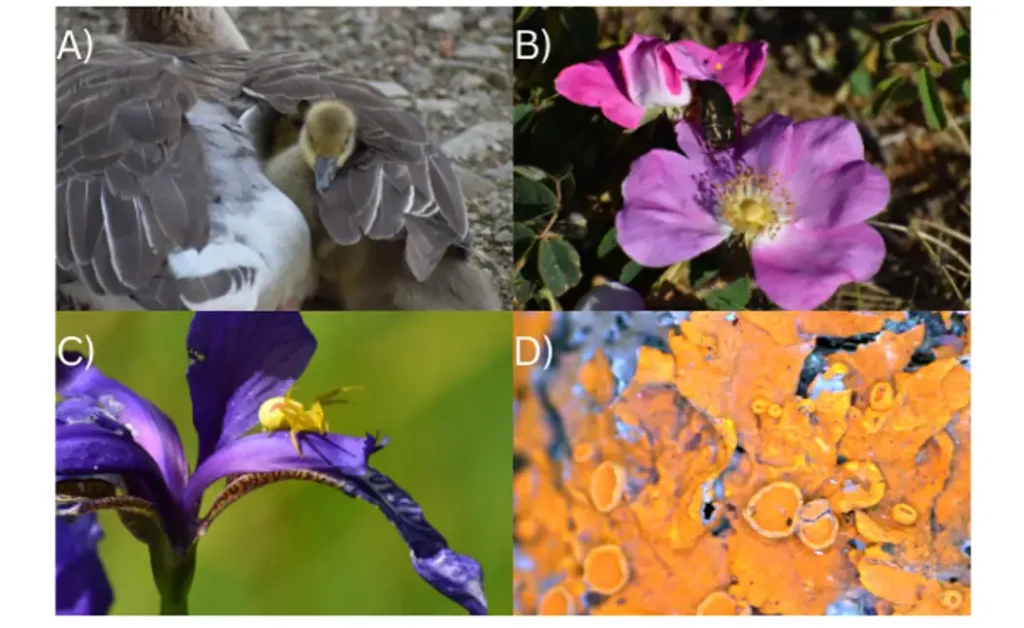
Figure 1. Take a closer look and you may discover a new and fascinating world. Pictures of Slovenian biodiversity: (A) a young greylag goose under an adult’s wing, (B) a flower chafer on a wild rose, (C) a flower crab spider on an iris flower, and (D) a lichen growing on tree bark, viewed under UV light. Photos: Jelena Komazec.
If you would like to discover more about the GOmini project and see more photos from our previous workshops, you can find the Department of Biodiversity, University of Primorska on Facebook (Oddelek za biodiverziteto / Department of Biodiversity) and Instagram (@biodiversity_up_famnit).
If you would like to participate in the project, we are also collecting short videos of interesting “mini” nature from the cross-border area of Italy and Slovenia. Young people and families can contribute their own recordings, some of which may become part of the project’s final results. The best submissions can also win practical prizes.
– Jelena, IVY Project Partner at University of Primorska / Univerza na Primorskem – Università del Litorale for the Interreg Italy-Slovenia project Gomini – Hidden Natural Heritage of the Cross-Border Area for Young Generations