Month: November 2026

Connecting Sicily and Malta through Cultural Heritage: My IVY experience with the CHORAL Project

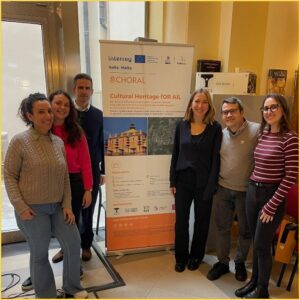
My name is Gabrielle, I am from France, and for the past 2 months I have been based in Palermo to take part in the Interreg Italy-Malta CHORAL (Cultural Heritage for All) project, as an IVY Project Partner. After graduating from a binational Master’s degree focused on Euro-Mediterranean relations, and having lived in both Malta and Italy, joining this cross-border initiative felt like a natural continuation of both my academic and personal journey. CHORAL: Enhancing Cultural Heritage The CHORAL project focuses on promoting cultural heritage while improving accessibility and digitalisation, bringing together partners from Sicily and Malta. The partnership combines complementary expertise: ARCES coordinates the project and facilitates cooperation among partners; Le Vie dei Tesori promotes heritage sites to wider audiences; Heritage Malta, the national agency responsible for museums and heritage sites, contributes its expertise in preservation and public engagement; while the University of Palermo and the University of Malta provide academic research and technological support. The goal of CHORAL is to improve both physical and digital accessibility to cultural heritage sites in Palermo and Malta. Officially launched in March 2025 at the Rabat Catacombs in Malta, the project explores new ways of experiencing heritage through workshops, collaborative activities, and innovative tools. One of its key outcomes will be the creation of 3D reconstructions of cultural sites, available in open access on a dedicated digital platform. In addition, informational totems will be installed in Palermo and Malta to guide visitors and provide accessible content, while educational resources will make the experience engaging for different audiences. These initiatives respond to a growing need for cultural heritage to move beyond traditional documentation of sites, buildings, and artefacts. By combining digital technologies with on-site interpretation, CHORAL seeks to create more inclusive and sustainable ways of discovering heritage. My role as IVY Project Partner Within ARCES, I support stakeholder coordination and contribute to several project activities, while learning from an experienced team in European project management. One of the most concrete tasks I have been involved in so far is linked to the accessibility of the Real Casina Cinese in Palermo, a unique royal residence located in the Parco della Favorita. As part of this work, in February we took part in activities to promote sustainable ways of accessing the site, encouraging visitors to use walking and cycling routes across Palermo. Through this experience, I am also discovering how EU Cohesion Policy works in practice. Projects like CHORAL demonstrate how European cooperation programmes can directly support local communities, promote cultural heritage, and strengthen connections between neighbouring regions such as Sicily and Malta. Personal and professional growth Deeply attached to the region and its cultural diversity, this experience is both enriching and inspiring. My ambition is to continue contributing to cross-border initiatives that promote accessibility and empower younger generations to engage in cooperation settings. In this perspective, joining the CHORAL project and ARCES team in Palermo has been an important step for both my personal and professional development. With a few more months ahead in my IVY experience, I look forward to continuing to learn from my colleagues and to seeing how the project evolves! – Gabrielle, IVY Project Partner at Ente Morale Associazione A.R.C.E.S, for the Interreg Italy-Malta project CHORAL – Cultural Heritage fOR AlL
Read More >

Volunteering at IVY Project CeMeWE: Is Education Enough to Integrate Immigrant Women Into the European Job Market?

Who would have known that only travelling to another country would reveal the real issue It is hard enough to land a job in your own country, but what about the environment with a completely new culture and a bizarre language you simply cannot comprehend? However, there is a way to reduce the stress and ease the transition, and I am a part of it. My name is Julita Viļuma, and as a part of the CeMeWE project team, I promote the opportunities for career growth and motivate other women to join the labor market by writing articles and being a helping hand for the project. Central Baltic Mentoring for Migrant Women seeking Employment or CeMeWE project is focused on integrating immigrant women into the workforce of the European labor markets by offering useful workshops and engaging activities that allow participants to build meaningful networks. Moreover, the project is implemented in 4 different countries – Sweden, Finland, Latvia, and Estonia – which allows it to reach a wider audience and help women with different backgrounds. The organized events vary from peer support mentoring groups to CV creation workshops. Though one thing stays the same- all of the events are tailored for skills improvement and career opportunity exploration. As part of the CeMeWE project, implemented at Laurea University in Finland, I had the opportunity to see how dedication can open doors to possibilities that seemed impossible and to gain valuable experience in writing and event management. As the Finnish branch is offering various peer support groups, I had the opportunity to see the progress of women with different backgrounds and needs. The most surprising group was the one in which women had no education. Even though they also struggled the most, the steps that they took towards finding their job were truly inspiring and showed how effort allows one to reach new heights. Of course, apart from seeing how women achieve their goals, I also had to write about their journey and the events that the CeMeWE project held. It was intriguing to see which conclusions the participants came to after the events and how they decided to act on the acquired knowledge For instance, Ukrainian women in the Zemgale planning region had created their own beauty salon after visiting events of the CeMeWE.  Furthermore, as I had participated in some events of this project even before joining the team as a volunteer, I had noticed such an effect on myself, as the LinkedIn workshop had inspired me to create a good LinkedIn profile, and the CV workshop, as well as the Photoshop workshop, helped me expand my network and learn new skills that I can use. All in all, I do truly believe that the goal of the CeMeWE project is within our reach, and I am really glad to be a part of the team with such a helpful mission. And now, the moment you have been waiting for, dear reader, yes, the education does indeed help immigrant women get integrated into the job market. Though by education I mean personal development, the process of learning new skills, and learning about the career opportunities that are available in the chosen country. – Julita, IVY Project Partner at Laurea University of Applied Sciences, for the Interreg Central Baltic project CeMeWe – The Central Baltic Mentoring for Migrant Women seeking Employment

Read More >

A Unique Experience: Discovering Sustainability in Aquaculture as an IVY Volunteer for AZA4ICE

Hello everyone, my name is Leonidas Stavrakakis, and I come from Crete, Greece. I am currently completing my studies in Civil Engineering at the University of Patras, having chosen the specialization that has become one of my greatest passions: Hydraulic and Environmental Engineering for Sustainable Infrastructure. Since I was a child, I have been fascinated by the natural environment and all the living and non-living elements it encompasses. I have participated in numerous volunteer initiatives, from cleaning beaches and wetlands to protecting wildlife and raising public awareness about the uniqueness and complexity of ecosystems. This year, I had the incredible opportunity to combine the scientific knowledge I have acquired at university with my love for the environment by joining the Interreg Volunteer Youth (IVY) initiative through the “AZA4ICE” project in Patras. “Allocated Zones for circular Aquaculture to trigger the transition to an Inclusive and Circular Economy in the aquaculture sector fostering new business opportunities and eco-consciousness society”, or simply AZA4ICE, is a project co-funded by the European Union through the Interreg Euro-MED Programme. Its goal is to address the challenges that made aquaculture highly polluting in the past, causing damage not only to the surrounding natural environment but also to the quality of the final product, the farmed fish themselves. AZA4ICE is a transnational partnership involving several countries, including my own, that examines the spatial planning of sustainable aquaculture in coastal and inland waters based on the principles of the circular economy. This approach not only empowers public bodies and private investors to develop new, innovative business ideas that yield high-quality, competitive products, but it also protects local marine and terrestrial environments through ecological design while simultaneously upgrading local communities. Although my academic journey has provided me with a solid foundation in environmental engineering, nothing compares to the practical application of this knowledge that my experience as an IVY volunteer offers. I learned about Integrated Multi-Trophic Aquaculture (IMTA) and how the circular economy principle can be applied in practice, specifically, how the “waste” of one organism becomes vital nourishment for another within an aquaculture system. We researched when a Recirculating Aquaculture System (RAS) is superior to an Aquaponics system and when it is not.  With the help of my colleagues, we analyzed seawater samples from existing aquaculture facilities, determining the concentrations of orthophosphates, ammonia, and nitrates, nutrients that can lead to eutrophication and hypoxia in enclosed marine areas, causing irreversible damage. I also learned about the licensing procedure for aquaculture facilities in my country and which authorities are responsible for reviewing and approving these permits. At last, together with my mentors, we created presentations that explain the value of projects like AZA4ICE in a simple, accessible way, intended to be used in schools across my country, while I am also currently working on an episode for the AZA4ICE podcast on Spotify. I truly hope the IVY program continues for many years to come, giving students and young people like me the chance to feel part of a broader society that thinks critically and ethically, producing work that benefits everyone, projects that do not pollute the environment but rather strengthen and fortify it for future generations. Through IVY, you will collaborate with many people, discuss ideas that once seemed like dreams, and work together to make them a reality. This experience unites people under a common goal, offering not only professional skills but also lifelong friendships. – Leonidas, IVY Project Partner at the University of Patras, for the Interreg Euro-MED project AZA4ICE

Read More >

Two Projects, One Goal: Territorial Cooperation

Hello! My name is Marzia and I am currently volunteering as an IVY Project Partner for two different Interreg projects at ICGEB in Trieste. I’m involved in two very different but equally interesting projects. On one side, there’s PROMOS, which focuses on supporting the Italian–Austrian biomedical ecosystem by encouraging collaboration and helping turn research into real-world applications. On the other, I’m contributing to CEDRIC, a project that aims to improve soil health by restoring its microbiological biodiversity through cross-border cooperation. Even though they work in different fields, both projects share the same goal: reducing disparities across borders and promoting sustainable development. It’s been almost three months since I started this experience, and I can honestly say I’m really enjoying it! Since Friuli Venezia Giulia is my home region, it feels especially meaningful to contribute to cooperation projects right here. One of the things I like most is the chance to meet new people, build connections, and discover different realities and opportunities in the area.  At the same time, I’m learning a lot on a professional level: from improving my communication skills, by working with events, social media, websites, webinars and press releases, to understanding how EU-funded projects actually work behind the scenes. Overall, I’m really grateful for this opportunity and I would definitely recommend it to anyone interested in cooperation and the European Union! – Marzia, IVY Project Partner at ICGEB, Trieste for the Interreg Projects PROMOS and CEDRIC, under Interreg Italia-Austria.

Read More >

Protecting Mediterranean Forests: My IVY Journey with StrategyMedFor

Hello everyone! My name is Micol, I’m 24 years old and I’m from Tuscany, Italy. I’m currently volunteering as an IVY Project Partner for the Interreg project “StrategyMedFor – Strategy for the Sustainable Management of Mediterranean Forests” under the Interreg Euro-MED programme. My host organization that is also leading the project, is The European Topic Centre – University of Malaga (ETC-UMA). What is “StrategyMedFor” about? StrategyMedFor’s main output is the development of a Strategy for Sustainable Management of Mediterranean Forests (SSMMF). It aims to create a strategy for each forest type, considering future climate scenarios. The project has determined criteria and subcriteria to define the status and quality of Mediterranean forests. Then these criteria were adapted to geodata ready to be used for generating a final map of priority areas for protection, restoration and resilient management. The methods were evaluated and tested in three pilot sites: in Greece, North Macedonia and Bosnia & Herzegovina. The StrategyMedFor project is more than just creating a plan – it’s about inspiring real change! Who’s Involved? The project is led by ETC-UMA and it counts seven partners from six countries of the Interreg Euro MED programme, and eight relevant associated partners from the forest EU & international scene. My Role as a Volunteer I arrived at ETC-UMA during the last phase of the project – and the last phase is all about transferring the knowledge! My tasks range from creating StoryMaps and sets of visual maps on ArcGIS Online, to communication work. Why IVY Matters? Being an IVY Project Partner is so much more than a volunteering experience. The IVY programme creates a unique bridge between passionate young people and meaningful European projects – proving that the next generation has a vital role to play in shaping Europe’s future. – Micol, IVY Project Partner at the European Topic Centre – University of Malaga (ETC-UMA)for the Interreg Euro-MED project “StrategyMedFor”

Read More >

Empowering Youth for the Blue Economy: My IVY Journey with ATLIC

I’m Stefano, and this year I started an IVY program in Lugo (Spain) with Vida Láctea. The main goal of my volunteering is to support the company in the communication, especially for what concerns ATLIC, an international project involving several partners across all the European Atlantic Area. The purpose of ATLIC (Atlantic Innoblue Communities) is to promote the concept of blue economy, i.e. an environmentally and economically sustainable model of growth for companies, organizations and communities connected whose existence is integrated with the ocean. Here in Lugo we are guiding a group of young people in the design of technological solutions that can benefit the blue economy: last year, for example, we supported a participant of the project in the creation of a robot to clean the beaches, and another one in the designing of a board game about the Galician maritime culture. Each of our partners are developing the same concept in their respective countries, to impulse the creation of even more ideas and stimulating the entrepreneurship abilities in the young people. We are also organizing local and international creative jams, competitions between groups of young people where they have a few days to develop an idea from scratch. In the last event, hosted by one of our Irish partners, Donegal Youth Service, between the 10th and 12th of March, I was mentoring one of the teams participating to the competition, and I gave a 3D printing workshop to a group of participants. I was also preparing contents for the communication of the event, including an online promotional video, a video presentation of the event to be projected on stage, the welcome kit with all the information about the event, and a final video that I’m editing right now. In April we are going to join with all the partners of the ATLIC project in Nantes, where the École de Design Nantes Atlantique will be hosting a presentation of all the ideas developed by the young people supported by each partner. I’m grateful for this opportunity, as it is giving me more insight on how European projects are written and carried on, and improving my communication skills, both in English and Spanish. – Stefano, IVY Project Partner at Vida Lactea, SLU, for the Interreg Atlantic Area project ATLIC – ATLANTIC INNOBLUE COMMUNITIES

Read More >

Connecting Sicily and Malta through Cultural Heritage: My IVY experience with the CHORAL Project

My name is Gabrielle, I am from France, and for the past 2 months I have been based in Palermo to take part in the Interreg Italy-Malta CHORAL (Cultural Heritage for All) project, as an IVY Project Partner. After graduating from a binational Master’s degree focused on Euro-Mediterranean relations, and having lived in both Malta and Italy, joining this cross-border initiative felt like a natural continuation of both my academic and personal journey. CHORAL: Enhancing Cultural Heritage The CHORAL project focuses on promoting cultural heritage while improving accessibility and digitalisation, bringing together partners from Sicily and Malta. The partnership combines complementary expertise: ARCES coordinates the project and facilitates cooperation among partners; Le Vie dei Tesori promotes heritage sites to wider audiences; Heritage Malta, the national agency responsible for museums and heritage sites, contributes its expertise in preservation and public engagement; while the University of Palermo and the University of Malta provide academic research and technological support. The goal of CHORAL is to improve both physical and digital accessibility to cultural heritage sites in Palermo and Malta. Officially launched in March 2025 at the Rabat Catacombs in Malta, the project explores new ways of experiencing heritage through workshops, collaborative activities, and innovative tools. One of its key outcomes will be the creation of 3D reconstructions of cultural sites, available in open access on a dedicated digital platform. In addition, informational totems will be installed in Palermo and Malta to guide visitors and provide accessible content, while educational resources will make the experience engaging for different audiences. These initiatives respond to a growing need for cultural heritage to move beyond traditional documentation of sites, buildings, and artefacts. By combining digital technologies with on-site interpretation, CHORAL seeks to create more inclusive and sustainable ways of discovering heritage. My role as IVY Project Partner Within ARCES, I support stakeholder coordination and contribute to several project activities, while learning from an experienced team in European project management. One of the most concrete tasks I have been involved in so far is linked to the accessibility of the Real Casina Cinese in Palermo, a unique royal residence located in the Parco della Favorita. As part of this work, in February we took part in activities to promote sustainable ways of accessing the site, encouraging visitors to use walking and cycling routes across Palermo. Through this experience, I am also discovering how EU Cohesion Policy works in practice. Projects like CHORAL demonstrate how European cooperation programmes can directly support local communities, promote cultural heritage, and strengthen connections between neighbouring regions such as Sicily and Malta. Personal and professional growth Deeply attached to the region and its cultural diversity, this experience is both enriching and inspiring. My ambition is to continue contributing to cross-border initiatives that promote accessibility and empower younger generations to engage in cooperation settings. In this perspective, joining the CHORAL project and ARCES team in Palermo has been an important step for both my personal and professional development. With a few more months ahead in my IVY experience, I look forward to continuing to learn from my colleagues and to seeing how the project evolves! – Gabrielle, IVY Project Partner at Ente Morale Associazione A.R.C.E.S, for the Interreg Italy-Malta project CHORAL – Cultural Heritage fOR AlL
Read More >

Volunteering at IVY Project CeMeWE: Is Education Enough to Integrate Immigrant Women Into the European Job Market?

Who would have known that only travelling to another country would reveal the real issue It is hard enough to land a job in your own country, but what about the environment with a completely new culture and a bizarre language you simply cannot comprehend? However, there is a way to reduce the stress and ease the transition, and I am a part of it. My name is Julita Viļuma, and as a part of the CeMeWE project team, I promote the opportunities for career growth and motivate other women to join the labor market by writing articles and being a helping hand for the project. Central Baltic Mentoring for Migrant Women seeking Employment or CeMeWE project is focused on integrating immigrant women into the workforce of the European labor markets by offering useful workshops and engaging activities that allow participants to build meaningful networks. Moreover, the project is implemented in 4 different countries – Sweden, Finland, Latvia, and Estonia – which allows it to reach a wider audience and help women with different backgrounds. The organized events vary from peer support mentoring groups to CV creation workshops. Though one thing stays the same- all of the events are tailored for skills improvement and career opportunity exploration. As part of the CeMeWE project, implemented at Laurea University in Finland, I had the opportunity to see how dedication can open doors to possibilities that seemed impossible and to gain valuable experience in writing and event management. As the Finnish branch is offering various peer support groups, I had the opportunity to see the progress of women with different backgrounds and needs. The most surprising group was the one in which women had no education. Even though they also struggled the most, the steps that they took towards finding their job were truly inspiring and showed how effort allows one to reach new heights. Of course, apart from seeing how women achieve their goals, I also had to write about their journey and the events that the CeMeWE project held. It was intriguing to see which conclusions the participants came to after the events and how they decided to act on the acquired knowledge For instance, Ukrainian women in the Zemgale planning region had created their own beauty salon after visiting events of the CeMeWE.  Furthermore, as I had participated in some events of this project even before joining the team as a volunteer, I had noticed such an effect on myself, as the LinkedIn workshop had inspired me to create a good LinkedIn profile, and the CV workshop, as well as the Photoshop workshop, helped me expand my network and learn new skills that I can use. All in all, I do truly believe that the goal of the CeMeWE project is within our reach, and I am really glad to be a part of the team with such a helpful mission. And now, the moment you have been waiting for, dear reader, yes, the education does indeed help immigrant women get integrated into the job market. Though by education I mean personal development, the process of learning new skills, and learning about the career opportunities that are available in the chosen country. – Julita, IVY Project Partner at Laurea University of Applied Sciences, for the Interreg Central Baltic project CeMeWe – The Central Baltic Mentoring for Migrant Women seeking Employment

Read More >

A Unique Experience: Discovering Sustainability in Aquaculture as an IVY Volunteer for AZA4ICE

Hello everyone, my name is Leonidas Stavrakakis, and I come from Crete, Greece. I am currently completing my studies in Civil Engineering at the University of Patras, having chosen the specialization that has become one of my greatest passions: Hydraulic and Environmental Engineering for Sustainable Infrastructure. Since I was a child, I have been fascinated by the natural environment and all the living and non-living elements it encompasses. I have participated in numerous volunteer initiatives, from cleaning beaches and wetlands to protecting wildlife and raising public awareness about the uniqueness and complexity of ecosystems. This year, I had the incredible opportunity to combine the scientific knowledge I have acquired at university with my love for the environment by joining the Interreg Volunteer Youth (IVY) initiative through the “AZA4ICE” project in Patras. “Allocated Zones for circular Aquaculture to trigger the transition to an Inclusive and Circular Economy in the aquaculture sector fostering new business opportunities and eco-consciousness society”, or simply AZA4ICE, is a project co-funded by the European Union through the Interreg Euro-MED Programme. Its goal is to address the challenges that made aquaculture highly polluting in the past, causing damage not only to the surrounding natural environment but also to the quality of the final product, the farmed fish themselves. AZA4ICE is a transnational partnership involving several countries, including my own, that examines the spatial planning of sustainable aquaculture in coastal and inland waters based on the principles of the circular economy. This approach not only empowers public bodies and private investors to develop new, innovative business ideas that yield high-quality, competitive products, but it also protects local marine and terrestrial environments through ecological design while simultaneously upgrading local communities. Although my academic journey has provided me with a solid foundation in environmental engineering, nothing compares to the practical application of this knowledge that my experience as an IVY volunteer offers. I learned about Integrated Multi-Trophic Aquaculture (IMTA) and how the circular economy principle can be applied in practice, specifically, how the “waste” of one organism becomes vital nourishment for another within an aquaculture system. We researched when a Recirculating Aquaculture System (RAS) is superior to an Aquaponics system and when it is not.  With the help of my colleagues, we analyzed seawater samples from existing aquaculture facilities, determining the concentrations of orthophosphates, ammonia, and nitrates, nutrients that can lead to eutrophication and hypoxia in enclosed marine areas, causing irreversible damage. I also learned about the licensing procedure for aquaculture facilities in my country and which authorities are responsible for reviewing and approving these permits. At last, together with my mentors, we created presentations that explain the value of projects like AZA4ICE in a simple, accessible way, intended to be used in schools across my country, while I am also currently working on an episode for the AZA4ICE podcast on Spotify. I truly hope the IVY program continues for many years to come, giving students and young people like me the chance to feel part of a broader society that thinks critically and ethically, producing work that benefits everyone, projects that do not pollute the environment but rather strengthen and fortify it for future generations. Through IVY, you will collaborate with many people, discuss ideas that once seemed like dreams, and work together to make them a reality. This experience unites people under a common goal, offering not only professional skills but also lifelong friendships. – Leonidas, IVY Project Partner at the University of Patras, for the Interreg Euro-MED project AZA4ICE

Read More >

Two Projects, One Goal: Territorial Cooperation

Hello! My name is Marzia and I am currently volunteering as an IVY Project Partner for two different Interreg projects at ICGEB in Trieste. I’m involved in two very different but equally interesting projects. On one side, there’s PROMOS, which focuses on supporting the Italian–Austrian biomedical ecosystem by encouraging collaboration and helping turn research into real-world applications. On the other, I’m contributing to CEDRIC, a project that aims to improve soil health by restoring its microbiological biodiversity through cross-border cooperation. Even though they work in different fields, both projects share the same goal: reducing disparities across borders and promoting sustainable development. It’s been almost three months since I started this experience, and I can honestly say I’m really enjoying it! Since Friuli Venezia Giulia is my home region, it feels especially meaningful to contribute to cooperation projects right here. One of the things I like most is the chance to meet new people, build connections, and discover different realities and opportunities in the area.  At the same time, I’m learning a lot on a professional level: from improving my communication skills, by working with events, social media, websites, webinars and press releases, to understanding how EU-funded projects actually work behind the scenes. Overall, I’m really grateful for this opportunity and I would definitely recommend it to anyone interested in cooperation and the European Union! – Marzia, IVY Project Partner at ICGEB, Trieste for the Interreg Projects PROMOS and CEDRIC, under Interreg Italia-Austria.

Read More >

Protecting Mediterranean Forests: My IVY Journey with StrategyMedFor

Hello everyone! My name is Micol, I’m 24 years old and I’m from Tuscany, Italy. I’m currently volunteering as an IVY Project Partner for the Interreg project “StrategyMedFor – Strategy for the Sustainable Management of Mediterranean Forests” under the Interreg Euro-MED programme. My host organization that is also leading the project, is The European Topic Centre – University of Malaga (ETC-UMA). What is “StrategyMedFor” about? StrategyMedFor’s main output is the development of a Strategy for Sustainable Management of Mediterranean Forests (SSMMF). It aims to create a strategy for each forest type, considering future climate scenarios. The project has determined criteria and subcriteria to define the status and quality of Mediterranean forests. Then these criteria were adapted to geodata ready to be used for generating a final map of priority areas for protection, restoration and resilient management. The methods were evaluated and tested in three pilot sites: in Greece, North Macedonia and Bosnia & Herzegovina. The StrategyMedFor project is more than just creating a plan – it’s about inspiring real change! Who’s Involved? The project is led by ETC-UMA and it counts seven partners from six countries of the Interreg Euro MED programme, and eight relevant associated partners from the forest EU & international scene. My Role as a Volunteer I arrived at ETC-UMA during the last phase of the project – and the last phase is all about transferring the knowledge! My tasks range from creating StoryMaps and sets of visual maps on ArcGIS Online, to communication work. Why IVY Matters? Being an IVY Project Partner is so much more than a volunteering experience. The IVY programme creates a unique bridge between passionate young people and meaningful European projects – proving that the next generation has a vital role to play in shaping Europe’s future. – Micol, IVY Project Partner at the European Topic Centre – University of Malaga (ETC-UMA)for the Interreg Euro-MED project “StrategyMedFor”

Read More >

Empowering Youth for the Blue Economy: My IVY Journey with ATLIC

I’m Stefano, and this year I started an IVY program in Lugo (Spain) with Vida Láctea. The main goal of my volunteering is to support the company in the communication, especially for what concerns ATLIC, an international project involving several partners across all the European Atlantic Area. The purpose of ATLIC (Atlantic Innoblue Communities) is to promote the concept of blue economy, i.e. an environmentally and economically sustainable model of growth for companies, organizations and communities connected whose existence is integrated with the ocean. Here in Lugo we are guiding a group of young people in the design of technological solutions that can benefit the blue economy: last year, for example, we supported a participant of the project in the creation of a robot to clean the beaches, and another one in the designing of a board game about the Galician maritime culture. Each of our partners are developing the same concept in their respective countries, to impulse the creation of even more ideas and stimulating the entrepreneurship abilities in the young people. We are also organizing local and international creative jams, competitions between groups of young people where they have a few days to develop an idea from scratch. In the last event, hosted by one of our Irish partners, Donegal Youth Service, between the 10th and 12th of March, I was mentoring one of the teams participating to the competition, and I gave a 3D printing workshop to a group of participants. I was also preparing contents for the communication of the event, including an online promotional video, a video presentation of the event to be projected on stage, the welcome kit with all the information about the event, and a final video that I’m editing right now. In April we are going to join with all the partners of the ATLIC project in Nantes, where the École de Design Nantes Atlantique will be hosting a presentation of all the ideas developed by the young people supported by each partner. I’m grateful for this opportunity, as it is giving me more insight on how European projects are written and carried on, and improving my communication skills, both in English and Spanish. – Stefano, IVY Project Partner at Vida Lactea, SLU, for the Interreg Atlantic Area project ATLIC – ATLANTIC INNOBLUE COMMUNITIES

Read More >