Hello everyone, my name is Leonidas Stavrakakis, and I come from Crete, Greece. I am currently completing my studies in Civil Engineering at the University of Patras, having chosen the specialization that has become one of my greatest passions: Hydraulic and Environmental Engineering for Sustainable Infrastructure.
Since I was a child, I have been fascinated by the natural environment and all the living and non-living elements it encompasses. I have participated in numerous volunteer initiatives, from cleaning beaches and wetlands to protecting wildlife and raising public awareness about the uniqueness and complexity of ecosystems. This year, I had the incredible opportunity to combine the scientific knowledge I have acquired at university with my love for the environment by joining the Interreg Volunteer Youth (IVY) initiative through the “AZA4ICE” project in Patras.

“Allocated Zones for circular Aquaculture to trigger the transition to an Inclusive and Circular Economy in the aquaculture sector fostering new business opportunities and eco-consciousness society”, or simply AZA4ICE, is a project co-funded by the European Union through the Interreg Euro-MED Programme.
Its goal is to address the challenges that made aquaculture highly polluting in the past, causing damage not only to the surrounding natural environment but also to the quality of the final product, the farmed fish themselves.
AZA4ICE is a transnational partnership involving several countries, including my own, that examines the spatial planning of sustainable aquaculture in coastal and inland waters based on the principles of the circular economy.
This approach not only empowers public bodies and private investors to develop new, innovative business ideas that yield high-quality, competitive products, but it also protects local marine and terrestrial environments through ecological design while simultaneously upgrading local communities.
Although my academic journey has provided me with a solid foundation in environmental engineering, nothing compares to the practical application of this knowledge that my experience as an IVY volunteer offers.
I learned about Integrated Multi-Trophic Aquaculture (IMTA) and how the circular economy principle can be applied in practice, specifically, how the “waste” of one organism becomes vital nourishment for another within an aquaculture system. We researched when a Recirculating Aquaculture System (RAS) is superior to an Aquaponics system and when it is not.
With the help of my colleagues, we analyzed seawater samples from existing aquaculture facilities, determining the concentrations of orthophosphates, ammonia, and nitrates, nutrients that can lead to eutrophication and hypoxia in enclosed marine areas, causing irreversible damage.
I also learned about the licensing procedure for aquaculture facilities in my country and which authorities are responsible for reviewing and approving these permits.
At last, together with my mentors, we created presentations that explain the value of projects like AZA4ICE in a simple, accessible way, intended to be used in schools across my country, while I am also currently working on an episode for the AZA4ICE podcast on Spotify.
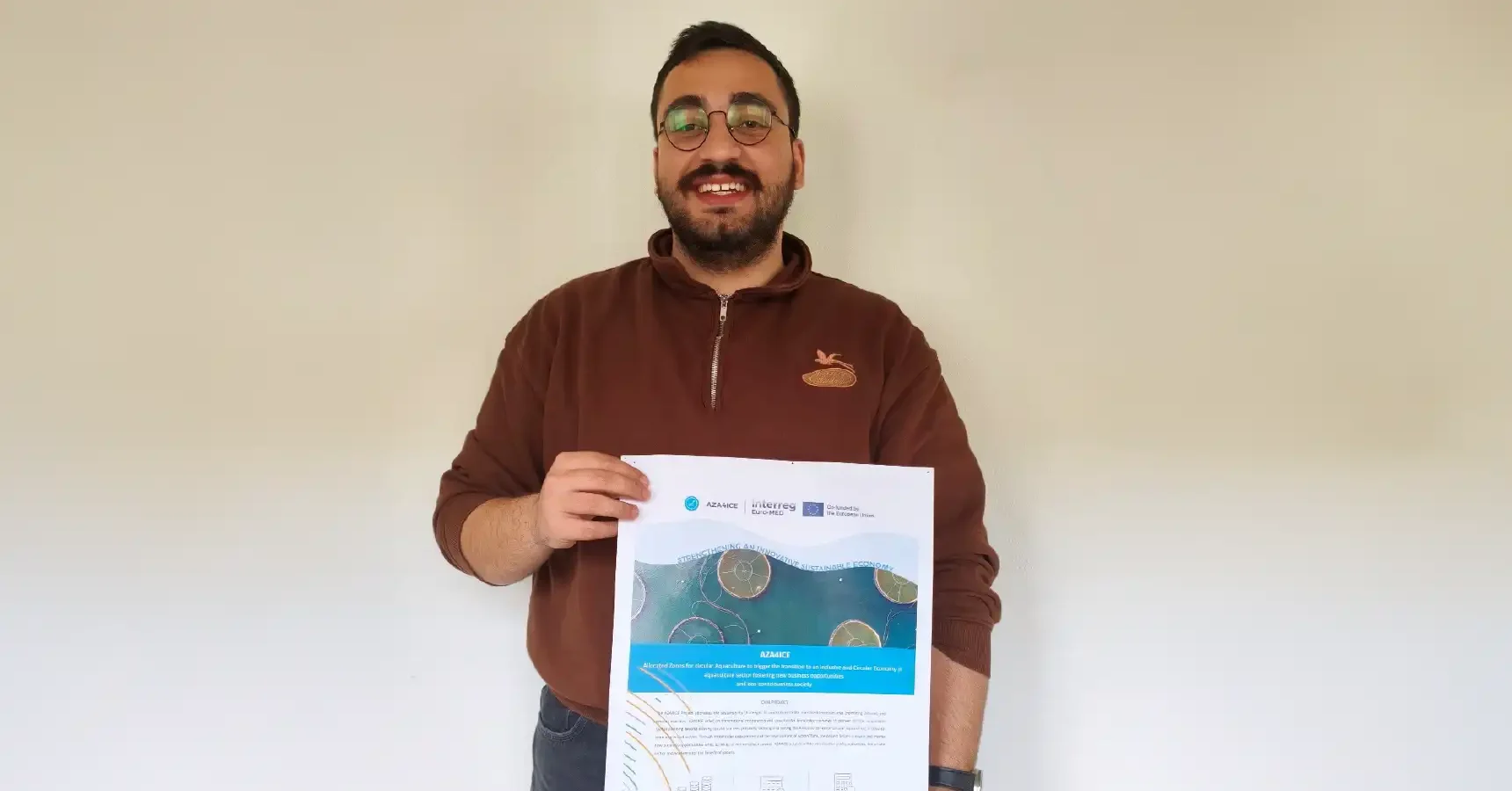
I truly hope the IVY program continues for many years to come, giving students and young people like me the chance to feel part of a broader society that thinks critically and ethically, producing work that benefits everyone, projects that do not pollute the environment but rather strengthen and fortify it for future generations.
Through IVY, you will collaborate with many people, discuss ideas that once seemed like dreams, and work together to make them a reality.
This experience unites people under a common goal, offering not only professional skills but also lifelong friendships.
– Leonidas, IVY Project Partner at the University of Patras, for the Interreg Euro-MED project AZA4ICE