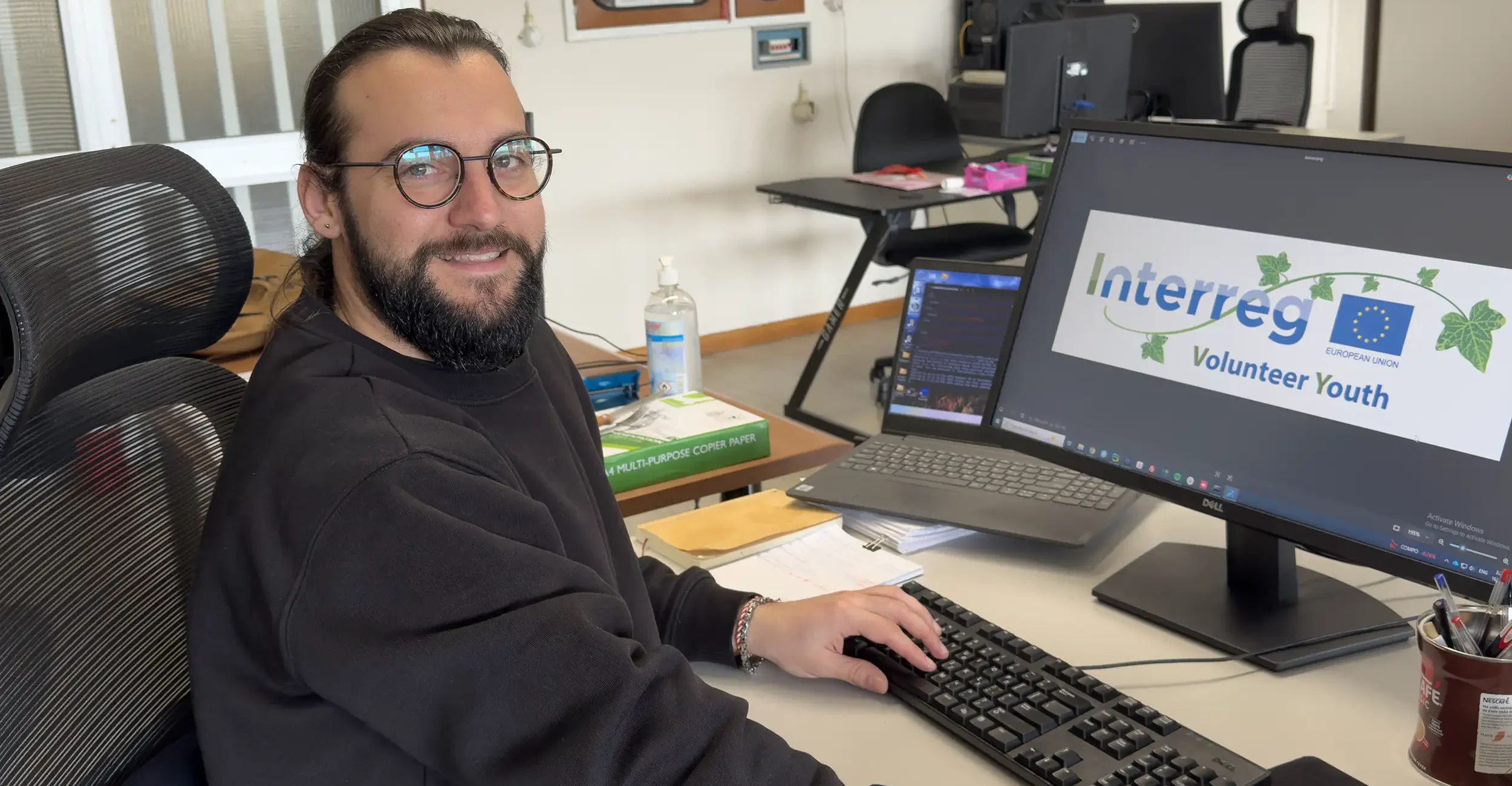
My name is Panagiotis Ioannidis, and since December I have been volunteering as an IVY Project Partner at the University of Patras, in the framework of the Interreg Euro-MED project Germ of Life (GoL). The project’s aim is to develop digital tools for drought risk management across the Mediterranean. When I first joined, I had only a general understanding of what European Territorial Cooperation meant in practice. A few months on, I can say it was one of the more formative experiences of my academic career. I would like to express my sincere gratitude to my host organisation, my mentor, and the IVY team — their guidance and support from the very beginning have made this experience both productive and rewarding.
What is the Germ of Life project?
The GoL project is co-financed by the Interreg Euro-MED Programme and brings together ten partners from six Mediterranean countries — Greece, Italy, Cyprus, Portugal, France, and Spain. The project’s aim is to develop an innovative digital system to help predict, monitor, and respond to drought risks, which are becoming increasingly severe across the Mediterranean due to climate change. The final output will be a Vulnerability Assessment Tool — a platform that gives early warnings about drought conditions and suggests tailored adaptation strategies for each of the project’s four pilot sites across the partner countries.

Who benefits?
Each pilot site faces its own unique drought-related challenges. The University of Patras is involved in the Greek pilot site, located in Aegialia, Western Greece — a semi-mountainous area known for its vineyards. Droughts in recent years have taken a serious toll on local viticulturists, reducing grape harvests and threatening livelihoods that have been part of the region’s identity for generations. The project aims to support farmers by providing them with data-driven early warnings, so they can prepare and adapt before conditions become critical. This represents a concrete and practical application of what EU-funded cooperation can achieve at the local level.
My role
My work at the University of Patras has been centred on literature review and data analysis. While this may sound primarily technical, in practice it has been a genuinely engaging and intellectually stimulating process. On the literature side, I have been reviewing scientific papers and existing research on drought indices, ecosystem vulnerability, and monitoring state-of-the-art. This foundational work is essential for ensuring that the tool the project develops is grounded in robust science, not only technically sound, but genuinely meaningful for the communities it is intended to serve. The data analysis component has been the area where my academic background has been proven most directly applicable. With the meteorological station at the Aegialia pilot site now operational, real measurements are being collected. Contributing to the team responsible for processing and interpreting this data, translating figures into meaningful insights about conditions on the ground, has given the work a clear sense of purpose. Each dataset represents a step toward a tool that could make a tangible difference for local farmers and the wider community.
Reflections on Cooperation and European Integration
One of the most notable aspects of this experience has been observing how much cross-institutional collaboration underpins a project of this scale. Working alongside experts from six different countries — each bringing distinct languages, academic traditions, and local contexts — and seeing them coordinate effectively toward a shared objective has been both instructive and motivating. The online meetings that bring together partners from across the Mediterranean serve as a constant reminder that this is not a local or national effort, but a genuinely European one. Prior to joining IVY, I had limited familiarity with the concept of Cohesion Policy. Having now observed how EU funding is channelled into concrete tools designed to support vulnerable communities, I have developed a much clearer understanding of its scope and value, and a genuine interest in communicating it to others. This, of course, is central to what the IVY initiative is all about.
Looking Ahead
This placement is still ongoing, and much remains to be accomplished. Nevertheless, I can already say with confidence that this volunteering experience has offered something that extends well beyond professional development: a meaningful understanding of what it means to work across borders in pursuit of a common goal. For those interested in learning more about IVY, the Interreg programme, or the Germ of Life project, I would encourage exploring these initiatives further. Volunteering through IVY offers a valuable opportunity to contribute meaningfully to European territorial cooperation and to gain a deeper, first-hand understanding of how EU-funded projects create real impact at the local level.
– Panagiotis Ioannidis, IVY Project Partner at the University of Patras for the Interreg Euro-MED Germ of Life project.