Category: Sin categoría

My IVY Experience – Supporting Cross-Border Cooperation through Early Language Learning

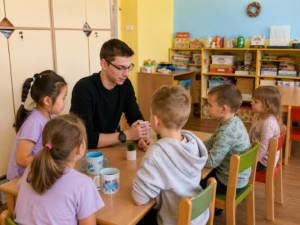
Hi, my name is Vojtěch, I am 26 years old and I am volunteering through the IVY programme at the host organisation Euregio Egrensis in the Czech Republic. My volunteering experience is connected to the project “Neighbour’s Language from the Start”, which focuses on supporting cross-border cooperation between Czech and German kindergartens. The project aims to introduce children to the language of the neighbouring country from an early age and to integrate language activities into the everyday life of kindergartens. The idea behind the project is that children become familiar with a language most naturally through authentic and everyday situations. It is therefore not only about learning individual words, but also about coming into contact with the culture, traditions and environment of the neighbouring country. In this way, children can gain their first personal experiences with the cross-border environment from an early age and learn to perceive the neighbouring country as a natural part of the region in which they live. The project involves five kindergartens on the Czech side and five institutions on the German side. On the Czech side, the participating kindergartens are located in Cheb, Sokolov, Kraslice, Skalná and Luby. On the German side, the participating institutions are Kita Quellenzwerge Bad Brambach, Kita Sonnenblick Wohlhausen, Kita Sonnenschein Klingenthal, Kita Juniorkiste Eichigt and Kita Marieney. The project therefore creates a common framework for cooperation between preschool institutions on both sides of the Saxon-Czech border. Since the beginning of my placement, I have had the opportunity to observe how cross-border cooperation works in practice. As part of the project activities and its documentation, I have visited all participating kindergartens on the Czech side and observed language animations in different educational environments. Each kindergarten has its own atmosphere, way of working and group dynamics, which has allowed me to notice how differently children can respond to activities connected to the language of the neighbouring country. An important part of the project is not only the language activities in kindergartens, but also cultural events, meetings with partners and the involvement of parents. Thanks to this, the project does not remain limited to individual kindergartens, but creates a broader space for meeting, sharing experiences and building relationships between people on both sides of the border. The support provided by the host organisation Euregio Egrensis has also played an important role in my volunteering experience. From the beginning, the project goals, activities and broader context were clearly introduced to me. This made it easier for me to become involved in an already established project and to gradually understand how individual activities contribute to its overall objectives. One of the most interesting aspects of this experience for me is seeing that cross-border cooperation becomes real not only at the level of institutions and project documents, but above all through everyday activities. Even simple language games, shared experiences or meetings can contribute to openness, understanding and a natural relationship with the neighbouring country. Being involved in this project also allows me to better understand the importance of European territorial cooperation and the role of initiatives such as Interreg and IVY in supporting local communities. The project shows that international cooperation can take a very concrete form and have a visible impact directly in regions, schools and among the youngest generation. Through this volunteering experience, I am gaining valuable insight into the implementation of a cross-border project, cooperation between partners and the practical benefits of Czech-German initiatives. It is motivating to see how a project developed at the European level can support concrete activities in local communities and contribute to long-term connections between people on both sides of the border. I am glad to be part of a project that supports cooperation, openness and creates opportunities for meeting and connecting from an early age. – Vojtěch, IVY Project Partner at the Regional Association of Municipalities and Towns Euregio Egrensis (Regionální sdružení obcí a měst Euregio Egrensis), for the Interreg project NLS – Jazyk sousedů od začátku ( Neighbour`s Language from the Start), under the programme Interreg Saxony – Czech Republic.
Read More >

My IVY experience in the Alps with the Interreg Alpine Space programme

Servus! Ich bin Prislaine und ich komme aus dem Südwesten Frankreichs… and honestly, that’s about where my German level ends! My daily challenge is the Austrian keyboard: every time I try to type a simple “m”, a “ö” appears instead. But hey, I still manage to get my work done (and order ice cream!), so I’d say I’m adapting just fine. On 7 April 2026, I joined the Interreg Alpine Space programme team in Salzburg, as a Reporter. Alongside my wonderful colleagues, we are part of the Joint Secretariat which carries out the day-to-day implementation of the programme. Our role is to support projects across seven Alpine countries (Austria, France, Germany, Italy, Liechtenstein, Slovenia and Switzerland) to tackle Alpine-specific challenges. I share this experience with my partner in crime, Helena, who is the intern of the programme. Together, we help the communication team bring these stories to life. My daily tasks include creating content for social media and helping with event logistics. To celebrate Europe Day, we organized an EU BUS QUIZ. It was a fun day where participants did a blind test and a quiz about Europe (the winner even got a little gift!). I also took charge of the programme’s application to the Interreg SLAM competition, writing the fictional story of Alma to highlight two of our projects dealing with snow and tourism. Even if my focus is on communication, it’s great because I can join meetings and trainings to get a broader view of European programmes. Outside of the office, Salzburg is a fantastic city. You can easily access wild nature, go for a hike or a bike ride, and even take a quick after-work swim in the lakes. So, if you see me hunting for the “m” key today, just know I’m busy writing my next chapter in the Alps. Schönen Tag! – Prislaine , IVY Reporter for the programme Interreg Alpine Space.

Read More >

My Experience with easyPEST

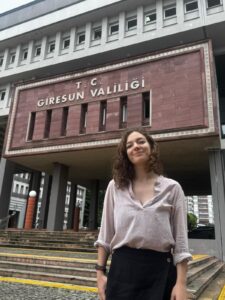
Hello from Giresun, the city of hazelnuts! I am Bensu Kurtay, a Sociology master’s student at Middle East Technical University (METU). As an Interreg Volunteer Youth (IVY), I’ve had the chance to join easyPEST – “Establishing long-term monitoring system for plant pests around the Black Sea”, a project funded by the Interreg NEXT Black Sea Basin Programme. The project was officially launched with a clear and important goal: to build a long-term monitoring system for plant pests around the Black Sea region. easyPEST combines artificial intelligence and citizen science to detect invasive plant pests early, before they can cause serious damage. By encouraging cross-border cooperation, the project aims to protect forests, secure agricultural production, and preserve biodiversity across the Black Sea Basin. The project is led by the Giresun Governorship (Turkey), together with partners from Greece and Georgia: Trabzon University, the Hellenic Agricultural Organization – DIMITRA (HAO-DIMITRA), and Ilia State University. This international mix means constant exchange of knowledge, methods, and experience between institutions with different backgrounds but a shared goal. Through this volunteering experience, I’ve been supporting the project’s reporting tasks, as well as visual and design work — helping with the website and social media presence. It’s been an interesting way to connect my academic background with an environmental, science-driven project like this one. And now comes the most exciting part of my volunteering: soon I’ll be heading up into the mountains of the Black Sea region together with expert biologists and entomologists, to take part in the actual pest-monitoring fieldwork! P.S. Thanks to IVY, I had the chance to come to Giresun for the first time, and I fell in love with the nature here. If you ever get the chance, please visit the Black Sea Region! I’m looking forward to sharing more about this hands-on experience soon. – Bensu, IVY Project Partner at the Giresun Governorship, for the Interreg project EasyPEST, under the programme Interreg NEXT Black Sea Basin.

Read More >

Seeing Europe through a different lens: My IVY journey within the EUSALP Secretariat in Nice

When I have started my volunteering experience as an IVY Reporter at the EUSALP Secretariat, I thought I knew what European cooperation looked like. I imagined meetings, policies, and institutional work taking place behind closed doors. A few months later, I have discovered something very different: European cooperation is, above all, about people. Since April, I have been part of the Communication Service, where I help bring the work of EUSALP to life through social media, content creation, photography, and video editing. Every day, I have the opportunity to transform ideas, events, and projects into stories that people can understand and connect with. What I enjoy most is that no two days are the same. One day I might be preparing content for social media, the next I am editing a video from an event or interviewing participants about their experience. Through the 4Support EUSALP project, I have helped showcase initiatives such as the 4Support Eusalp kick-off, Pitch Your Project, the AI Hackathon, the Digital Alps Conference, the Macro-Regional Strategies (MRS) Days, the EUSALP Annual Forum, and the Energy Award. Each event has introduced me to new ideas, inspiring people, and innovative projects that demonstrate how cooperation can make a real difference across the Alpine region. What has surprised me the most is everything I have learned beyond communication itself. Before joining the Secretariat, I knew very little about macro-regional strategies. I had heard the term “cross-border cooperation,” but it remained quite abstract to me. Today, I understand that it is something much more tangible. It is regions choosing to work together instead of separately. It is experts, local authorities, researchers, entrepreneurs, and young people sharing their knowledge to tackle common challenges from climate change and energy transition to innovation and digitalisation. Being behind the scenes has allowed me to see the amount of collaboration, commitment, and passion that goes into every initiative. The events I help communicate are not simply conferences or meetings; they are places where ideas become partnerships and where discussions can lead to concrete projects that benefit people across borders. As someone working in communication, this has also changed the way I see my own role. Communication is not just about publishing posts or producing videos. It is about giving visibility to the people behind the projects, making European initiatives more accessible, and helping citizens understand why cooperation matters in their everyday lives. Every story shared, every interview recorded, and every video published becomes another way of connecting Europe with its citizens. This experience has also helped me grow personally. I have strengthened my skills in digital communication, visual storytelling, and video production, while becoming more confident working in an international environment. Most importantly, I have learned to adapt, to be curious, and to appreciate the value of teamwork across cultures and languages. Looking back, I realise that my IVY experience is about much more than professional development. It has given me a new perspective on Europe itself. Instead of seeing European cooperation as something distant, I now see the people behind it: colleagues who are passionate about their work, project partners who believe in collaboration, and young innovators eager to contribute to a more sustainable future. This experience has reminded me that Europe is built every day not only through policies, but through conversations, partnerships, creativity, and trust. I feel grateful to contribute to this process by helping tell the stories of those who are making it happen. My journey at the EUSALP Secretariat is still ongoing, and I know there is much more to learn. But one thing is already certain: this experience has strengthened my interest in European affairs and shown me that communication has the power to make cooperation visible, meaningful, and inspiring. Sometimes, all it takes is telling the right story to remind people that Europe is not just a mapit is a community working together across borders.   – Adeline, IVY Reporter for the EUSALP Technical Support Secretariat

Read More >

Rethinking Sharing: My Experience with the Digital Kiosks Project

“What if we didn’t need to own everything we use?” This question has accompanied me throughout my IVY experience in Saint-Quentin, France, where I have been working on the “DIGITAL KIOSKS – Innovative public-private-people partnerships to implement new infrastructure (digital kiosks) for the Sharing Economy of Goods” project, led by the City of Saint-Quentin, within the Interreg North Sea Programme. Digital Kiosks brings together partners from several European countries to test a network of shared stations where citizens can access everyday items on demand. Tools, household equipment or sports materials are made available collectively rather than individually owned, encouraging a more efficient use of resources at local level. Within this framework, I contribute to the communication activities of the project. My role focuses on supporting the dissemination of project content and results, ensuring that complex or technical information is translated into formats that are accessible and relevant for a broader audience. What I find particularly relevant in this process is how communication becomes part of the project itself: it is not only about visibility, but about making cooperation understandable beyond institutional circles. A significant part of my experience has also been the participation in transnational project meetings. These exchanges offer a concrete perspective on how European cooperation operates in practice. Beyond the formal structure of the programme, what emerges is a continuous process of negotiation and alignment between different working cultures, priorities and local contexts. Despite these differences, there is a consistent effort to develop shared solutions that can be applied across borders. Before this experience, I associated European cooperation mainly with its institutional and administrative dimension. Working within an Interreg project has shifted this perspective. Cooperation becomes tangible in the way partners exchange knowledge, adapt approaches, and collectively refine ideas through implementation. From this perspective, the Digital Kiosks project is not only about shared infrastructure, but about testing a different logic of access and consumption. The idea of borrowing rather than owning is not presented as innovation in itself, but as a practical response to questions of resource use that many communities are already facing. Overall, this experience has helped me understand European cooperation as a process that is embedded in practice rather than abstract policy. Its value lies less in declarations of intent and more in the gradual construction of solutions through collaboration. If I had to describe Interreg today, I would not refer to it in institutional terms. I would describe it as the space where ideas are translated into practices that can be tested, adjusted and eventually integrated into everyday life.   – Margherita, IVY Project Partner at the Municipality of Saint-Quentin, for the Interreg project DIGITAL KIOSKS, under the programme Interreg North Sea.

Read More >

Making Europe from Galicia: my IVY experience at INCUBTRANS

Being an IVY volunteer at the Galicia Europa Foundation is allowing me to discover in a very close way how European cooperation can be translated into concrete actions. Through this experience, I have been able to better understand what cohesion policy means and how projects like INCUBTRANS help strengthen local communities on both sides of the border. INCUBTRANS is a cross-border cooperation project focused on the Galicia–North Portugal Euroregion. Its objective is to create a cross-border incubator that supports the sustainable creation of new companies, promotes qualified employment and generates added value in the territory, especially in the surroundings of the Eurocidade Chaves-Verín. In my case, I have been able to contribute to the project from several different tasks. I have participated in meetings of the project steering committee, where I was able to closely follow the progress of the project, its priorities and the way in which the partners cooperate to coordinate activities and monitor the results. I also had the opportunity to work on identifying the sectors of local commerce that present the most difficulties in the area of Chaves and Verín, which allowed me to better understand the economic reality of the area and reflect on the challenges of trade in a cross-border context. In addition, I have collaborated in communication tasks, writing press releases on project activities and working on the INCUBTRANS Social Network Report, analyzing its presence on social networks and the content disseminated. Another aspect that has had a great impact on my experience has been dissemination. At the O Porriño job fair, at the III conference “boost your future” organized by the UNED and at the event “Xuventude rumbo a Europa”, I was able to share my experience as an IVY volunteer and explain the opportunities offered by both this program and the territorial cooperation projects for young people. What I value the most and what has made me grow the most during this volunteering is that it has allowed me to combine learning and real participation. Not only was I able to learn more about how different entities in Galicia and Portugal cooperate, but I also had the opportunity to give visibility to the impact that Interreg projects can have on people’s lives and on the development of more connected and cohesive territories. – Aitor, IVY Project Partner at Galicia Europa Foundation, for the Interreg project INCUBTRANS, under the programme Interreg POCTEP.

Read More >

My IVY Experience – Supporting Cross-Border Cooperation through Early Language Learning

Hi, my name is Vojtěch, I am 26 years old and I am volunteering through the IVY programme at the host organisation Euregio Egrensis in the Czech Republic. My volunteering experience is connected to the project “Neighbour’s Language from the Start”, which focuses on supporting cross-border cooperation between Czech and German kindergartens. The project aims to introduce children to the language of the neighbouring country from an early age and to integrate language activities into the everyday life of kindergartens. The idea behind the project is that children become familiar with a language most naturally through authentic and everyday situations. It is therefore not only about learning individual words, but also about coming into contact with the culture, traditions and environment of the neighbouring country. In this way, children can gain their first personal experiences with the cross-border environment from an early age and learn to perceive the neighbouring country as a natural part of the region in which they live. The project involves five kindergartens on the Czech side and five institutions on the German side. On the Czech side, the participating kindergartens are located in Cheb, Sokolov, Kraslice, Skalná and Luby. On the German side, the participating institutions are Kita Quellenzwerge Bad Brambach, Kita Sonnenblick Wohlhausen, Kita Sonnenschein Klingenthal, Kita Juniorkiste Eichigt and Kita Marieney. The project therefore creates a common framework for cooperation between preschool institutions on both sides of the Saxon-Czech border. Since the beginning of my placement, I have had the opportunity to observe how cross-border cooperation works in practice. As part of the project activities and its documentation, I have visited all participating kindergartens on the Czech side and observed language animations in different educational environments. Each kindergarten has its own atmosphere, way of working and group dynamics, which has allowed me to notice how differently children can respond to activities connected to the language of the neighbouring country. An important part of the project is not only the language activities in kindergartens, but also cultural events, meetings with partners and the involvement of parents. Thanks to this, the project does not remain limited to individual kindergartens, but creates a broader space for meeting, sharing experiences and building relationships between people on both sides of the border. The support provided by the host organisation Euregio Egrensis has also played an important role in my volunteering experience. From the beginning, the project goals, activities and broader context were clearly introduced to me. This made it easier for me to become involved in an already established project and to gradually understand how individual activities contribute to its overall objectives. One of the most interesting aspects of this experience for me is seeing that cross-border cooperation becomes real not only at the level of institutions and project documents, but above all through everyday activities. Even simple language games, shared experiences or meetings can contribute to openness, understanding and a natural relationship with the neighbouring country. Being involved in this project also allows me to better understand the importance of European territorial cooperation and the role of initiatives such as Interreg and IVY in supporting local communities. The project shows that international cooperation can take a very concrete form and have a visible impact directly in regions, schools and among the youngest generation. Through this volunteering experience, I am gaining valuable insight into the implementation of a cross-border project, cooperation between partners and the practical benefits of Czech-German initiatives. It is motivating to see how a project developed at the European level can support concrete activities in local communities and contribute to long-term connections between people on both sides of the border. I am glad to be part of a project that supports cooperation, openness and creates opportunities for meeting and connecting from an early age. – Vojtěch, IVY Project Partner at the Regional Association of Municipalities and Towns Euregio Egrensis (Regionální sdružení obcí a měst Euregio Egrensis), for the Interreg project NLS – Jazyk sousedů od začátku ( Neighbour`s Language from the Start), under the programme Interreg Saxony – Czech Republic.
Read More >

My IVY experience in the Alps with the Interreg Alpine Space programme

Servus! Ich bin Prislaine und ich komme aus dem Südwesten Frankreichs… and honestly, that’s about where my German level ends! My daily challenge is the Austrian keyboard: every time I try to type a simple “m”, a “ö” appears instead. But hey, I still manage to get my work done (and order ice cream!), so I’d say I’m adapting just fine. On 7 April 2026, I joined the Interreg Alpine Space programme team in Salzburg, as a Reporter. Alongside my wonderful colleagues, we are part of the Joint Secretariat which carries out the day-to-day implementation of the programme. Our role is to support projects across seven Alpine countries (Austria, France, Germany, Italy, Liechtenstein, Slovenia and Switzerland) to tackle Alpine-specific challenges. I share this experience with my partner in crime, Helena, who is the intern of the programme. Together, we help the communication team bring these stories to life. My daily tasks include creating content for social media and helping with event logistics. To celebrate Europe Day, we organized an EU BUS QUIZ. It was a fun day where participants did a blind test and a quiz about Europe (the winner even got a little gift!). I also took charge of the programme’s application to the Interreg SLAM competition, writing the fictional story of Alma to highlight two of our projects dealing with snow and tourism. Even if my focus is on communication, it’s great because I can join meetings and trainings to get a broader view of European programmes. Outside of the office, Salzburg is a fantastic city. You can easily access wild nature, go for a hike or a bike ride, and even take a quick after-work swim in the lakes. So, if you see me hunting for the “m” key today, just know I’m busy writing my next chapter in the Alps. Schönen Tag! – Prislaine , IVY Reporter for the programme Interreg Alpine Space.

Read More >

My Experience with easyPEST

Hello from Giresun, the city of hazelnuts! I am Bensu Kurtay, a Sociology master’s student at Middle East Technical University (METU). As an Interreg Volunteer Youth (IVY), I’ve had the chance to join easyPEST – “Establishing long-term monitoring system for plant pests around the Black Sea”, a project funded by the Interreg NEXT Black Sea Basin Programme. The project was officially launched with a clear and important goal: to build a long-term monitoring system for plant pests around the Black Sea region. easyPEST combines artificial intelligence and citizen science to detect invasive plant pests early, before they can cause serious damage. By encouraging cross-border cooperation, the project aims to protect forests, secure agricultural production, and preserve biodiversity across the Black Sea Basin. The project is led by the Giresun Governorship (Turkey), together with partners from Greece and Georgia: Trabzon University, the Hellenic Agricultural Organization – DIMITRA (HAO-DIMITRA), and Ilia State University. This international mix means constant exchange of knowledge, methods, and experience between institutions with different backgrounds but a shared goal. Through this volunteering experience, I’ve been supporting the project’s reporting tasks, as well as visual and design work — helping with the website and social media presence. It’s been an interesting way to connect my academic background with an environmental, science-driven project like this one. And now comes the most exciting part of my volunteering: soon I’ll be heading up into the mountains of the Black Sea region together with expert biologists and entomologists, to take part in the actual pest-monitoring fieldwork! P.S. Thanks to IVY, I had the chance to come to Giresun for the first time, and I fell in love with the nature here. If you ever get the chance, please visit the Black Sea Region! I’m looking forward to sharing more about this hands-on experience soon. – Bensu, IVY Project Partner at the Giresun Governorship, for the Interreg project EasyPEST, under the programme Interreg NEXT Black Sea Basin.

Read More >

Seeing Europe through a different lens: My IVY journey within the EUSALP Secretariat in Nice

When I have started my volunteering experience as an IVY Reporter at the EUSALP Secretariat, I thought I knew what European cooperation looked like. I imagined meetings, policies, and institutional work taking place behind closed doors. A few months later, I have discovered something very different: European cooperation is, above all, about people. Since April, I have been part of the Communication Service, where I help bring the work of EUSALP to life through social media, content creation, photography, and video editing. Every day, I have the opportunity to transform ideas, events, and projects into stories that people can understand and connect with. What I enjoy most is that no two days are the same. One day I might be preparing content for social media, the next I am editing a video from an event or interviewing participants about their experience. Through the 4Support EUSALP project, I have helped showcase initiatives such as the 4Support Eusalp kick-off, Pitch Your Project, the AI Hackathon, the Digital Alps Conference, the Macro-Regional Strategies (MRS) Days, the EUSALP Annual Forum, and the Energy Award. Each event has introduced me to new ideas, inspiring people, and innovative projects that demonstrate how cooperation can make a real difference across the Alpine region. What has surprised me the most is everything I have learned beyond communication itself. Before joining the Secretariat, I knew very little about macro-regional strategies. I had heard the term “cross-border cooperation,” but it remained quite abstract to me. Today, I understand that it is something much more tangible. It is regions choosing to work together instead of separately. It is experts, local authorities, researchers, entrepreneurs, and young people sharing their knowledge to tackle common challenges from climate change and energy transition to innovation and digitalisation. Being behind the scenes has allowed me to see the amount of collaboration, commitment, and passion that goes into every initiative. The events I help communicate are not simply conferences or meetings; they are places where ideas become partnerships and where discussions can lead to concrete projects that benefit people across borders. As someone working in communication, this has also changed the way I see my own role. Communication is not just about publishing posts or producing videos. It is about giving visibility to the people behind the projects, making European initiatives more accessible, and helping citizens understand why cooperation matters in their everyday lives. Every story shared, every interview recorded, and every video published becomes another way of connecting Europe with its citizens. This experience has also helped me grow personally. I have strengthened my skills in digital communication, visual storytelling, and video production, while becoming more confident working in an international environment. Most importantly, I have learned to adapt, to be curious, and to appreciate the value of teamwork across cultures and languages. Looking back, I realise that my IVY experience is about much more than professional development. It has given me a new perspective on Europe itself. Instead of seeing European cooperation as something distant, I now see the people behind it: colleagues who are passionate about their work, project partners who believe in collaboration, and young innovators eager to contribute to a more sustainable future. This experience has reminded me that Europe is built every day not only through policies, but through conversations, partnerships, creativity, and trust. I feel grateful to contribute to this process by helping tell the stories of those who are making it happen. My journey at the EUSALP Secretariat is still ongoing, and I know there is much more to learn. But one thing is already certain: this experience has strengthened my interest in European affairs and shown me that communication has the power to make cooperation visible, meaningful, and inspiring. Sometimes, all it takes is telling the right story to remind people that Europe is not just a mapit is a community working together across borders.   – Adeline, IVY Reporter for the EUSALP Technical Support Secretariat

Read More >

Rethinking Sharing: My Experience with the Digital Kiosks Project

“What if we didn’t need to own everything we use?” This question has accompanied me throughout my IVY experience in Saint-Quentin, France, where I have been working on the “DIGITAL KIOSKS – Innovative public-private-people partnerships to implement new infrastructure (digital kiosks) for the Sharing Economy of Goods” project, led by the City of Saint-Quentin, within the Interreg North Sea Programme. Digital Kiosks brings together partners from several European countries to test a network of shared stations where citizens can access everyday items on demand. Tools, household equipment or sports materials are made available collectively rather than individually owned, encouraging a more efficient use of resources at local level. Within this framework, I contribute to the communication activities of the project. My role focuses on supporting the dissemination of project content and results, ensuring that complex or technical information is translated into formats that are accessible and relevant for a broader audience. What I find particularly relevant in this process is how communication becomes part of the project itself: it is not only about visibility, but about making cooperation understandable beyond institutional circles. A significant part of my experience has also been the participation in transnational project meetings. These exchanges offer a concrete perspective on how European cooperation operates in practice. Beyond the formal structure of the programme, what emerges is a continuous process of negotiation and alignment between different working cultures, priorities and local contexts. Despite these differences, there is a consistent effort to develop shared solutions that can be applied across borders. Before this experience, I associated European cooperation mainly with its institutional and administrative dimension. Working within an Interreg project has shifted this perspective. Cooperation becomes tangible in the way partners exchange knowledge, adapt approaches, and collectively refine ideas through implementation. From this perspective, the Digital Kiosks project is not only about shared infrastructure, but about testing a different logic of access and consumption. The idea of borrowing rather than owning is not presented as innovation in itself, but as a practical response to questions of resource use that many communities are already facing. Overall, this experience has helped me understand European cooperation as a process that is embedded in practice rather than abstract policy. Its value lies less in declarations of intent and more in the gradual construction of solutions through collaboration. If I had to describe Interreg today, I would not refer to it in institutional terms. I would describe it as the space where ideas are translated into practices that can be tested, adjusted and eventually integrated into everyday life.   – Margherita, IVY Project Partner at the Municipality of Saint-Quentin, for the Interreg project DIGITAL KIOSKS, under the programme Interreg North Sea.

Read More >

Making Europe from Galicia: my IVY experience at INCUBTRANS

Being an IVY volunteer at the Galicia Europa Foundation is allowing me to discover in a very close way how European cooperation can be translated into concrete actions. Through this experience, I have been able to better understand what cohesion policy means and how projects like INCUBTRANS help strengthen local communities on both sides of the border. INCUBTRANS is a cross-border cooperation project focused on the Galicia–North Portugal Euroregion. Its objective is to create a cross-border incubator that supports the sustainable creation of new companies, promotes qualified employment and generates added value in the territory, especially in the surroundings of the Eurocidade Chaves-Verín. In my case, I have been able to contribute to the project from several different tasks. I have participated in meetings of the project steering committee, where I was able to closely follow the progress of the project, its priorities and the way in which the partners cooperate to coordinate activities and monitor the results. I also had the opportunity to work on identifying the sectors of local commerce that present the most difficulties in the area of Chaves and Verín, which allowed me to better understand the economic reality of the area and reflect on the challenges of trade in a cross-border context. In addition, I have collaborated in communication tasks, writing press releases on project activities and working on the INCUBTRANS Social Network Report, analyzing its presence on social networks and the content disseminated. Another aspect that has had a great impact on my experience has been dissemination. At the O Porriño job fair, at the III conference “boost your future” organized by the UNED and at the event “Xuventude rumbo a Europa”, I was able to share my experience as an IVY volunteer and explain the opportunities offered by both this program and the territorial cooperation projects for young people. What I value the most and what has made me grow the most during this volunteering is that it has allowed me to combine learning and real participation. Not only was I able to learn more about how different entities in Galicia and Portugal cooperate, but I also had the opportunity to give visibility to the impact that Interreg projects can have on people’s lives and on the development of more connected and cohesive territories. – Aitor, IVY Project Partner at Galicia Europa Foundation, for the Interreg project INCUBTRANS, under the programme Interreg POCTEP.

Read More >